MemHash
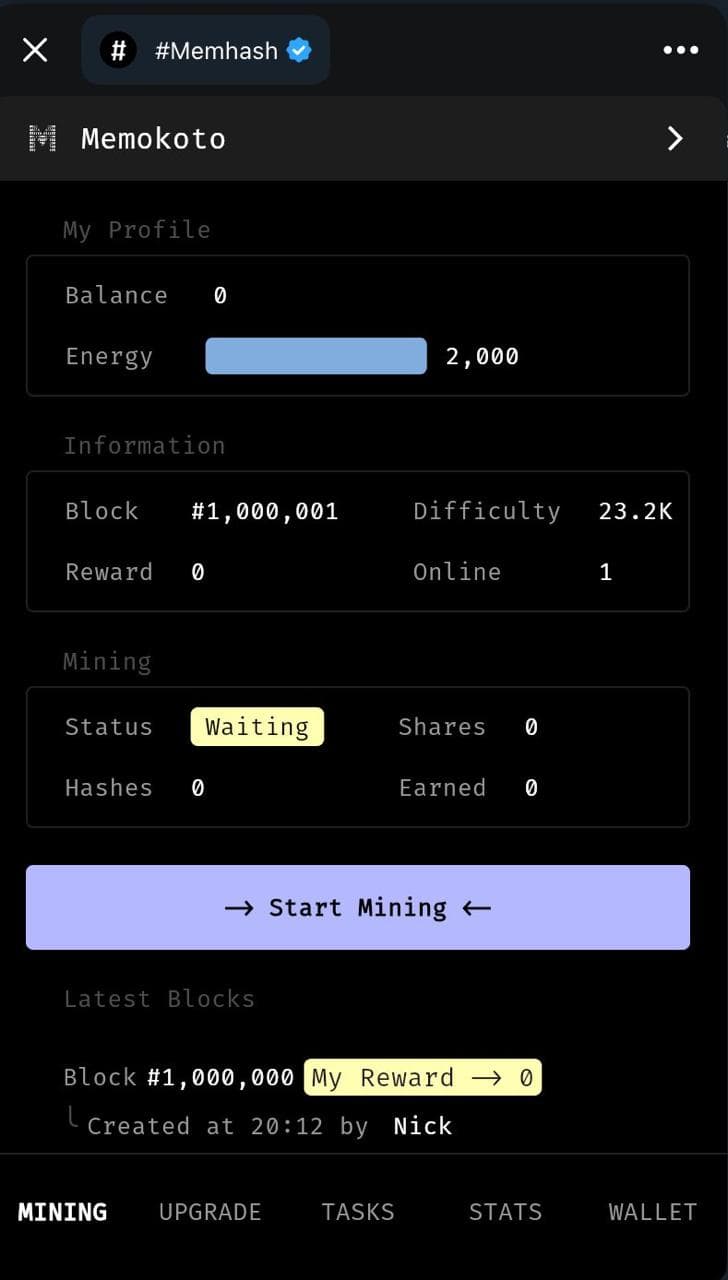
A pseudo-mining game with a real on-chain economy. Players trade hash power between each other, smart contracts settle rewards, prices form through bonding curves — all inside a Telegram Mini App.
The problem we were hired to solve.
Earlier mining-game attempts broke into farms within a week, ran on fixed token-per-tap rates that ignored supply, and patched anti-cheat reactively. Players could see the floor; bots could see it faster.
Hash-power becomes an order book. Bonding curve is the price oracle. Every reward is a contract call. Anti-bot rejects bad signups before they ever earn a hash. Live WebSocket feeds keep the dashboard honest.
Context
Most clicker-style mining games skip the hard parts: anti-bot, real tokenomics, and a price discovery layer that isn't a fixed multiplier. The brief was to build a mining game that behaves like an actual market — hash-power as a tradable asset, every settlement on-chain, and an anti-cheat layer that holds up to the kind of farms that ruin clicker economies in week two.
Approach
Node.js bot core on grammY for the entrypoint plus a Telegram Mini App for the trading and mining UI. FunC smart contracts on TON handle reward distribution and hash-power transfers — every trade and every block reward is a settled on-chain operation, not an internal ledger entry. Bonding curves live on-contract so price discovery is structural, not editorial. WebSocket gateway pushes live prices to all open clients without polling. Anti-bot layer combines device fingerprinting, behavioural rate-limit, and TON Connect wallet age checks — most farm operators bounce on signup. Postgres for user state, Redis for hot mining counters, BullMQ for retry queues on contract calls.
How this project was actually made.
Every project leaves a paper trail. Figma comments, Notion specs, GitHub history, Vercel deploy logs, Telegram threads, first-week analytics. Numbers below are real and available on request under NDA.
◆ Screenshots of any artifact available on request. Confidential details redacted.
Key features
- ◆
- ◆
- ◆
- ◆
- ◆
Results
Hash-power trades settle in under two seconds at peak. First month rejected 12,000+ bot/farm signup attempts before they touched the economy. Stable above 8,000 concurrent miners. Owner ships balance changes by editing a contract — not a config file.
Tech stack
What the client said.
Wanted a Telegram mining game that didn't collapse the moment farms found it. The team built a real on-chain economy — hash power as a tradable asset, FunC contracts for every settlement, an anti-bot layer that actually filters. First month rejected twelve thousand farm signups. The economy held.